


Short answer: On 26 October 2026 Google updated its guide to preventing user-generated spam with two additions: pages users create for sharing or utility, not meant to be found in Search, should be kept out of Google's index by default; and site owners should watch for spam signals in Search Console. Business sites with open comments, reviews, sign-up forms or pages generated from user input should run the checks below. Daaistudio sums up what changed and how we are adapting client work.
What changed
Google Search Central's documentation changelog for 26 October 2026 records an update to the guide to preventing user-generated spam, to help platforms keep pages not meant for Search out of the index and catch spam earlier. The additions:
- Wider scope: the guide now names tools that let users publish shared pages, generated content or web apps, beyond classic comments and forums.
- New section, only index content meant for Search: decide whether each type of user-created page is meant for search discovery or only for sharing by link. Pages for sharing, collaboration or utility should get noindex, or be blocked in robots.txt, by default.
- Monitoring in Search Console: verify the site to receive Manual actions and Security issues alerts, and check the Page Indexing and Performance reports regularly for unexpected spikes in pages, impressions or unrelated queries.
- Platform metrics: set alerts for sudden jumps in new public pages, or a few users creating most of the indexable URLs.
The existing advice stays: publish an abuse policy, noindex posts from new users until they earn trust, add rel="ugc" or "nofollow" to user links, moderate before publishing, block repeat offenders, and use reCAPTCHA or similar against automated sign-ups. The guide opens with the view that "Preventing abuse on your platform or site is usually not hard." (Google Search Central)
What it means for Thai businesses
- Not only a big-platform issue: WordPress sites with open blog comments, WooCommerce shops with product reviews, sites with member accounts, and pages generated from what customers type in are all ways spam gets in.
- The spam sits under your domain: Google's spam policies list user-generated spam as one type of spam and note that site owners are often unaware of it, while sites that break the policies may rank lower or not appear at all. Customers who find odd sales pages on a company site lose trust too.
- Utility pages are not sales pages: price calculator results, booking confirmations and link-shared pages are not meant to be found in Search. Left indexable, they fill the site with thin pages that do nothing.
- AI reads the same pages: a clean index, holding only the pages the owner wants seen, helps Google and AI read the business facts correctly.
How we are adapting our client work
Nothing in the guide calls for rebuilding a site, but it adds a few checks to routines we already run.
- Search Console in the business's name from day one: on every site we build, the client owns Search Console and adds us as a user, so Manual actions and Security issues alerts reach both the owner and the care team.
- Page Indexing added to the monthly report: on the SEO GEO plan we already review Search Console every month. We now compare the number of indexed pages with the pages the site really has, and check Performance for queries unrelated to the business.
- Ask of every page whether it is meant for Search: when an unfamiliar URL shows up, we check whether it is meant to be found. If not, we suggest noindex rather than deleting it on the spot.
- Security monitoring on the care plan: the monthly care plan includes a firewall, security monitoring and plugin updates, and we never use pirated (nulled) plugins, a common way for spam code to get into a site.
- Forms tested for real: the forms on our own site use a hidden honeypot field that the server actually reads to stop bots, and on every site we hand over we submit the forms for real to make sure customer messages reach the inbox.
An example from our work: Brasserie 9, a French restaurant in Sathorn, appears on Google's first page for French restaurant Sathorn. The page Google shows is the page the restaurant wants people to see, and that is what keeping the index clean protects.
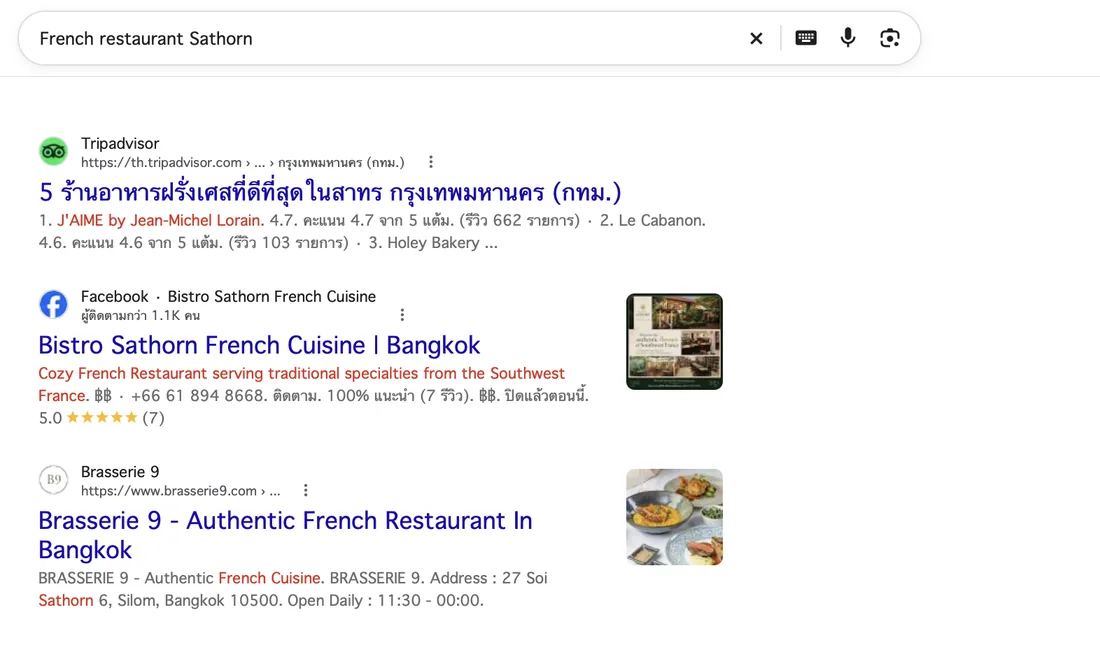
The Brasserie 9 website on Google's first page for French restaurant Sathorn (screenshot from the client report, October 2026). You can search this term yourself; results vary by location and time.
We hold a 5.0 rating on Google and Fastwork, from 18 Fastwork jobs with 8 repeat clients, and Al Saray and Brasserie 9 renewed for 6 months after their first 3.
What to do now: a short checklist
- Open Search Console, make sure the owner account is in the business's name, and check Manual actions and Security issues
- In the Page Indexing report, check that the number of indexed pages is close to the number of pages the site really has
- In the Performance report, look for odd searches unrelated to the business, such as casino, loans or pharmacy terms
- If you do not use WordPress comments, turn them off; if you do, require approval before they appear
- Make sure links in comments and reviews carry rel="ugc" or "nofollow", as in Google's guidance
- Add reCAPTCHA or another bot check to sign-up and contact forms
- Give pages meant for sharing or utility, such as booking confirmations, a noindex rule



Not sure whether your site has hidden spam pages?
Send us your site. In the free analysis plan we look at where users can post, which pages Google has indexed, and basic spam signals, then tell you what to fix first.
For the bigger picture of how Google and AI find a website, read SEO, AEO, AIO and GEO explained, and see what the care plan covers in Yearly website care costs. No one can guarantee Google rankings or AI answers; we show only real, measurable results.
Sources
- Google Search Central: Prevent user-generated spam on your site and platform (updated 26 Oct 2026)
- Google Search Central: Latest documentation updates (26 Oct 2026)
- Google Search Central: Spam policies, user-generated spam
- Google Search Central: Qualify your outbound links
- Google Search Central: Block Search indexing with noindex